Somewhere along the way, “cat owner” got treated like a design sentence you had to serve: carpeted towers in the corner, a plastic tray by the couch, a shredded armrest you’ve stopped apologizing for. It doesn’t have to go that way. You can have a cat and a living room that still looks like the one you’d photograph. The two goals aren’t at war; they’ve just been badly matched by most of the stuff on the market.
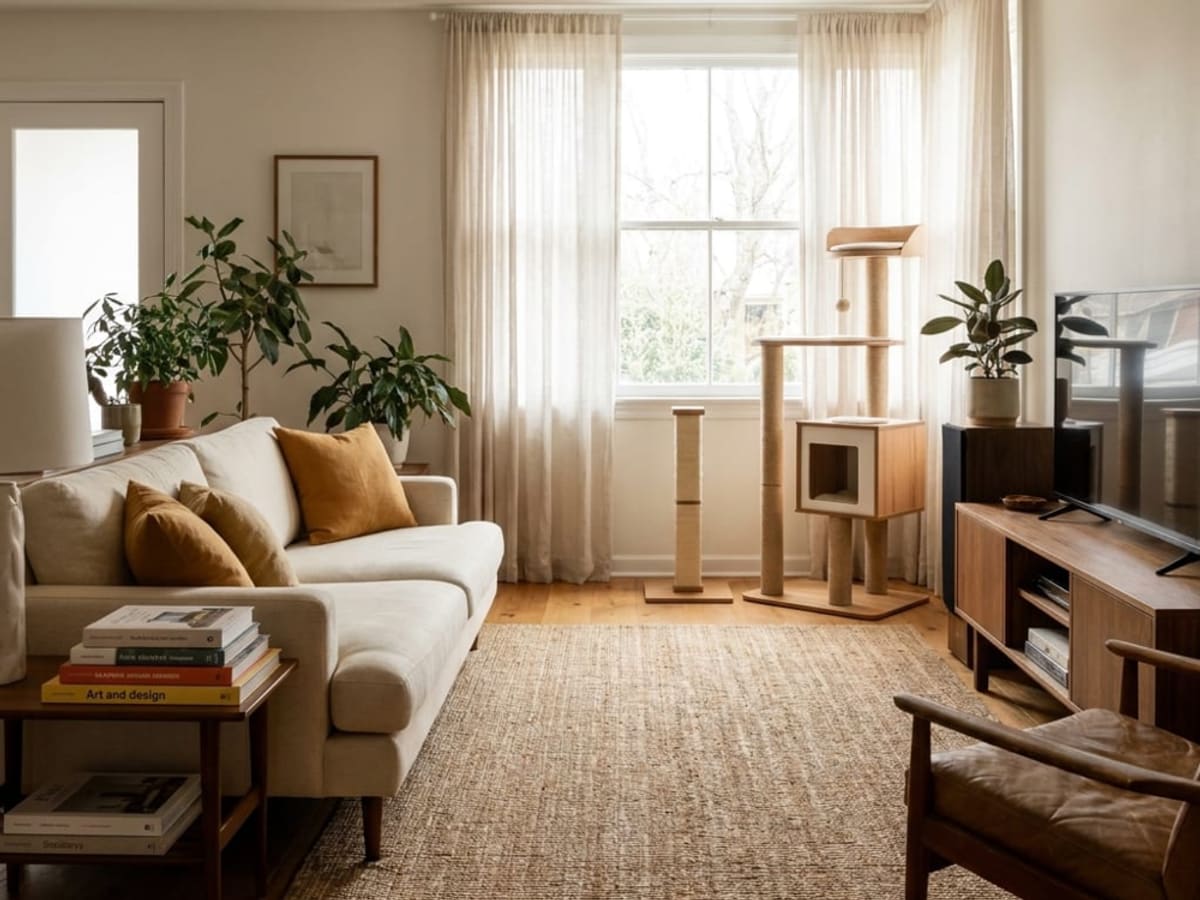
This guide is a decor-first playbook, written for the people the design blogs skip: renters who can’t renovate, studio and one-bedroom dwellers counting every square foot, and anyone who cares how the room reads. The idea is simple. Instead of bolting “cat gear” onto a space you love, you fold your cat’s real needs — height, scratching, a private bathroom, cozy perches, food and water — into pieces that already fit your taste. Done right, a stranger walks in and sees a well-styled room. Your cat walks in and sees a playground built for them.
There’s even a name for leaning into this on purpose: catcore. Not the doormat-that-says-”cat-mom” kind, but the tasteful kind, where you stop hiding that a cat lives here and start choosing cat things that genuinely suit your aesthetic. Warm woods, natural fibers, sculptural shapes that happen to be a scratching post. Catcore is the difference between tolerating the cat’s footprint on your decor and designing with it. Here’s how to do it, theme by theme.
Go vertical: height without the floor clutter
The single most useful thing you can do for a cat in a small apartment is give it height, and the single best thing you can do for your floor space is to put that height on the walls. Cats want to climb, survey, and nap somewhere elevated — it’s instinct, not preference. In a big house you solve that with a giant tower. In 500 square feet, the floor is too precious to donate to one.
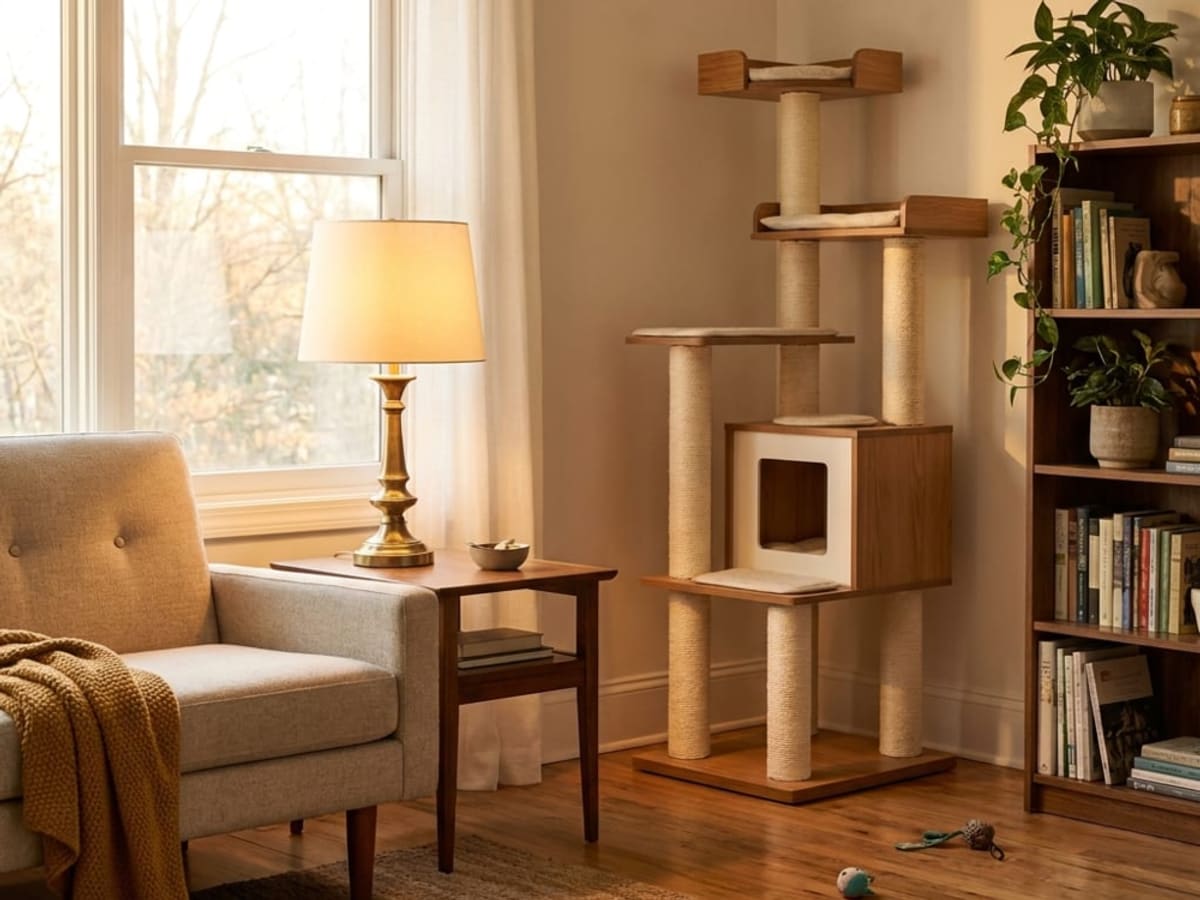
Vertical routes fix both problems at once. A staggered run of wall-mounted shelves turns a blank wall into a climbing route that reads as floating shelving until the cat uses it. It costs you no floor at all, draws the eye upward (which makes a small room feel taller), and gives the cat the high ground it actually wants. When you do want a freestanding piece, choose one designed to look like furniture rather than gym equipment: a slim, wood-toned tree that stands next to the sofa without shouting.
Plan the two together: shelves for the vertical highway, one good tree as the anchor and jumping-off point. For the wall side, see my roundup of cat wall shelves for small apartments; for the freestanding anchor, my picks for modern cat trees with a mid-century look. Between them you get all the height a cat craves and almost none of the clutter you don’t.
Make the litter box disappear
Nothing undoes a carefully styled room faster than a plastic tray in the corner. It announces “a cat lives here” before a guest has taken off their shoes, and in a studio there’s no spare room to banish it to; the box has to live where you live. The good news is this is one of the most solvable problems in the whole apartment.
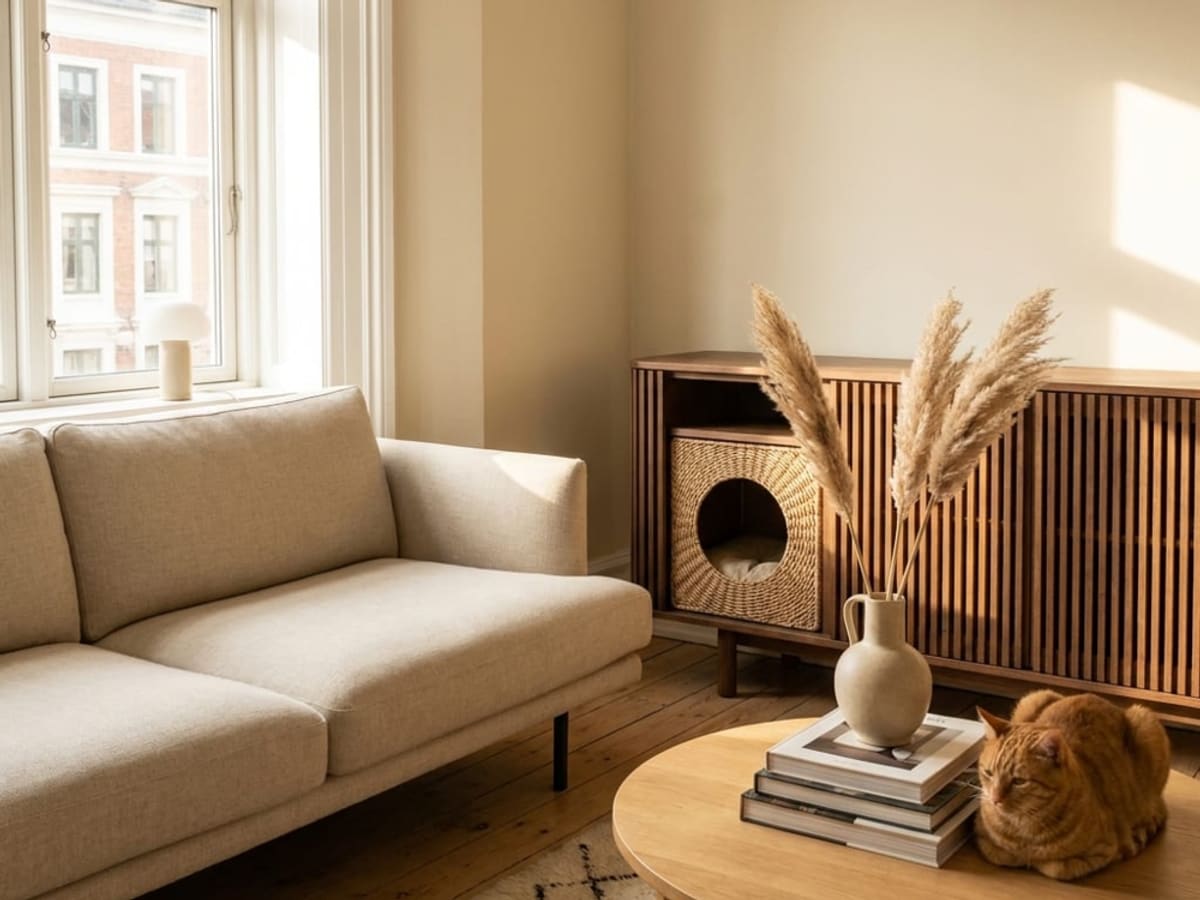
The move is to hide the box from your eyes without changing the things your cat cares about: easy access, a roomy pan, and good airflow. A furniture-style enclosure does exactly that: a cabinet or bench with a cat-sized entry cut into the side, the pan tucked inside, the whole thing reading as a console or side table. The cat gets the private, dim space many cats prefer; you get a surface for a lamp instead of an eyesore. Cheaper, lighter-touch options exist too: a nook, a screen, a repurposed cabinet.
The one rule that governs all of them: never trade away ventilation or cleaning access for looks, or you’ll end up with odor and a cat that quietly stops using the box. For the full method, see how to hide a litter box, and when you’re ready to pick an actual piece, my roundup of furniture-style litter enclosures.
Protect your furniture in style
Scratching isn’t your cat being spiteful; it’s a hardwired need to stretch, mark territory, and keep claws healthy. You can’t train it out, but you can redirect it, and redirecting is far easier when the alternative you offer is more appealing than your sofa. The trick is placement plus material: put a scratcher right where the cat already scratches (usually near where it sleeps or by the furniture it’s targeting) and give it a texture cats prefer: sisal, cardboard, or rough wood all beat your upholstery’s weave.
The reason most people fail at this is that they buy an ugly scratcher, hide it in a back corner, and then wonder why the cat ignores it. A scratcher only works if it lives in the prime real estate the cat wants, which means it has to be something you’re willing to display. That’s where design matters: a sculptural scratching post, a curved cardboard lounger, or a wall-mounted sisal panel can sit in the open as an object, not an apology.
Pair that with fabrics that fight back on the furniture itself — more on materials below — and you’ve solved scratching from both ends. For pieces you’ll actually leave in view, see my roundup of stylish cat scratchers that earn their spot in the room.
Cozy spots that read as decor
Cats sleep a huge share of the day, and they’ll pick the spot that feels safest and warmest whether or not you’ve provided a good one, which is how you end up with fur ground into the throw on your nicest chair. Give them a better option and they’ll usually take it, especially if it’s warm, slightly enclosed, and near a window or a sightline they like to monitor.
The design opportunity here is that a cat bed doesn’t have to look like a cat bed. A low felt dome, a woven basket, a bentwood-framed lounger: plenty of modern beds read as a decor object first and a pet bed second, so you can place one in the open without it dragging the room down. Position matters as much as the piece: cats gravitate to warmth and vantage points, so a bed near a radiator or a sunny sill gets used far more than one shoved in a dim corner.
And don’t overlook the window itself. A window perch or hammock gives a cat the two things it wants most — a warm sunbeam and a view of the outside world — while taking up zero floor and adding almost nothing visual to the room. For the sleeping side, see my picks for modern cat beds; for the window, my roundup of cat window perches and hammocks.
A feeding station that fits the kitchen
The feeding zone is where cat gear most often turns tacky: a plastic double bowl on a cartoon placemat, sliding around the kitchen floor. It’s an easy fix, and a small one visually if you treat the station like part of the kitchen rather than an afterthought stuck to the baseboard.
Start with the bowls. Ceramic or stainless in a shape and color that suits your kitchen instantly looks more intentional than molded plastic, and it’s better for the cat too, since plastic scratches and harbors bacteria over time, and many cats prefer a wide, shallow dish that doesn’t press on their whiskers. A raised feeder lifts the bowls to a more comfortable eating height and, as a bonus, reads as a considered piece rather than a puddle of dishes on the floor.
Water deserves its own thought. Cats are notoriously reluctant drinkers, and many are drawn to moving water, so a quiet fountain can genuinely get a cat drinking more, while looking like a small ceramic or stone object on the counter or floor rather than a novelty gadget. Keep the water station a little apart from the litter area, since cats instinctively won’t drink next to where they eliminate. For the dishes, see modern cat bowls and raised feeders; for hydration, my roundup of modern cat water fountains.
The “catcore” aesthetic: how to lean in tastefully
Once you stop fighting the fact that a cat lives here, catcore becomes a styling choice rather than a compromise. The whole idea is to choose cat things that already belong to the aesthetic you like, so the room gains warmth instead of losing coherence. A few principles keep it tasteful rather than kitsch.
Favor natural materials. Warm woods, sisal, wool felt, rattan, and stone all photograph beautifully and happen to be exactly what cats like to scratch, climb, and curl up on, so the cat-friendly choice and the good-looking choice keep turning out to be the same choice. Plastic is where things read cheap; natural fiber is where they read designed.
Keep the palette calm. A neutral base (warm whites, oatmeal, clay, soft greys, wood tones) lets the cat’s pieces disappear into the room instead of clashing with it, and it flatters most cats’ coats as a bonus. Then let shape do the talking: a sculptural scratching post, a domed felt bed, a curved wall run. Choose pieces you’d be happy to have in the room even if no one knew their function, and repeat a material or two across them so the cat’s footprint feels intentional. That’s catcore done right: not hiding the cat, but styling around it.
Small-apartment and studio specifics
A studio asks more of every object because there are no walls to hide behind; everything is on display all the time, and the cat’s stuff can’t retreat to a spare room. The answer is to zone and to double up.
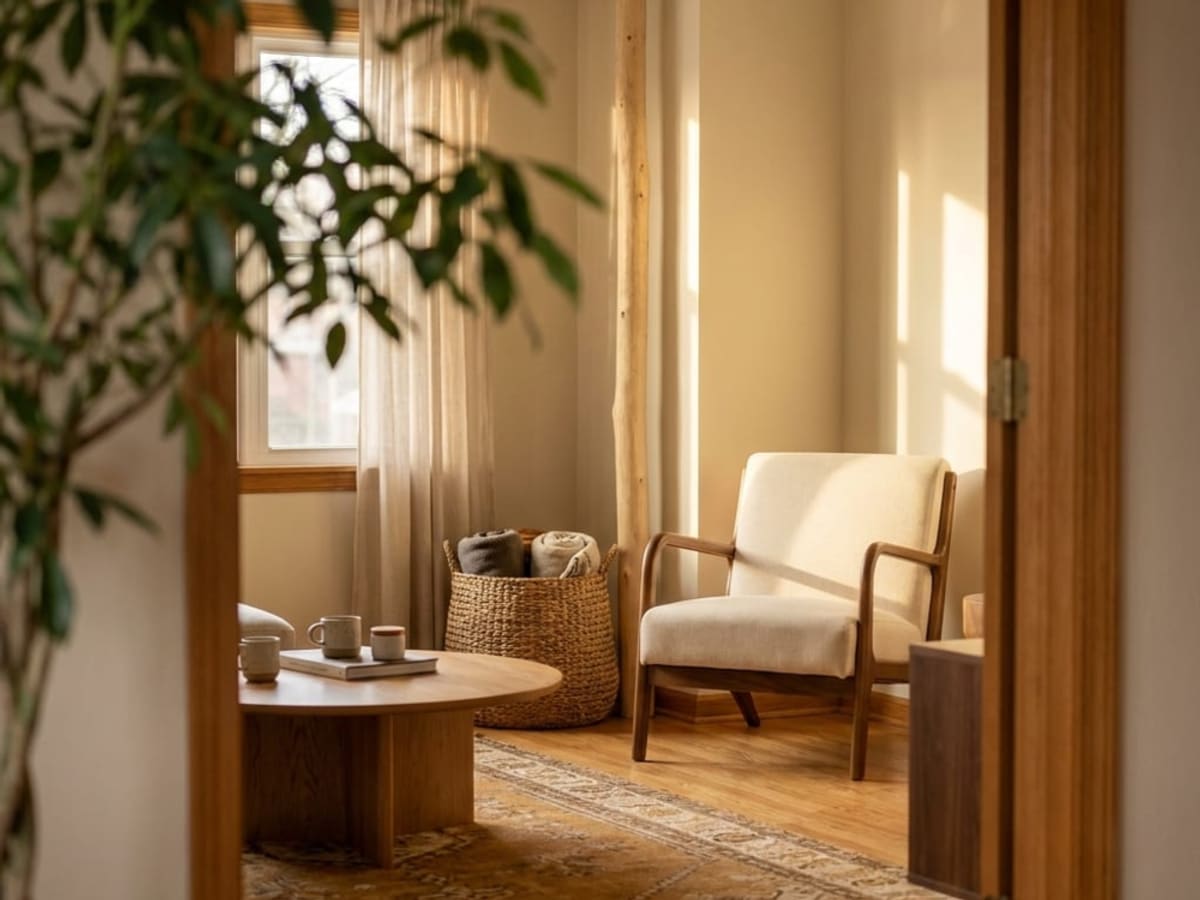
Zoning gives a small space structure. Use a rug, a low shelf, or the back of the sofa to imply separate areas — a lounging zone, a feeding corner, a cat perch by the window — so the room feels considered rather than like one bin of furniture and cat gear jumbled together. The cat benefits too: a clear feeding spot away from the litter area, and a quiet perch away from the door, matches how cats like to organize their world.
Multi-use pieces earn their keep twice over. A litter enclosure that’s also a side table, a cat tree that doubles as a bookshelf, a storage bench a cat naps on. Every object that serves two purposes is one you didn’t have to find floor for. And keep your sightlines clean: run the vertical stuff up the walls, keep the floor as open as you can, and resist crowding the low zone with gear. A small room reads calm when the eye has somewhere to rest, and height plus restraint is how you get there with a cat in the mix.
Cat-safe materials, fabrics, and plants
Material choice is where you protect both the room and the cat. On upholstery, the goal is fabric that resists claws and hides fur. Tightly woven, flat fabrics give claws less to snag than loose, looping weaves: the loops of a boucle or a chunky knit are exactly what a claw catches and pulls. Performance fabrics (the tight synthetics made for durability and cleaning) hold up well and wipe down easily, and leather, while it can scratch, tends not to snag and pull the way a woven loop does. Whatever you choose, matching the fabric roughly to your cat’s coat color makes shed fur far less visible between vacuum sessions. None of this replaces giving the cat a better scratching option nearby; material is the second line of defense, not the first.
Plants are where a warning belongs. Greenery does more than almost anything to make a room feel alive, but some common houseplants are genuinely unsafe for cats, and the details matter more than any quick list can capture. I’m not going to tell you which specific plants are fine. That’s exactly the kind of claim you shouldn’t take on faith from a decor guide. Before you bring any plant home, check it against the ASPCA’s toxic and non-toxic plant list, which is the authoritative, searchable reference and is updated as understanding changes. Treat that as a hard step, not a suggestion: look up the exact plant, and if you can’t confirm it’s safe or you can’t keep it fully out of the cat’s reach, choose something else. When in doubt, ask your veterinarian.
For the furniture side of all this — the actual pieces that make a small space work for both of you — see my guide to modern cat furniture.
FAQ
What is catcore?
Catcore is the tasteful version of leaning into having a cat: instead of hiding the fact that a cat lives with you, you choose cat pieces that genuinely fit your aesthetic, so the room gains warmth rather than losing coherence. In practice it means natural materials (warm wood, sisal, wool, rattan), a calm neutral palette, and sculptural shapes that happen to serve a cat’s needs: a scratching post that looks like an object, a felt dome bed, a run of wall shelves. The point isn’t cat-themed kitsch; it’s designing with the cat’s footprint on purpose so it looks intentional.
How do I make a small apartment cat-friendly?
Work vertically and double up. Give the cat height on the walls, with a run of shelves or a slim tree, so it gets the climbing and vantage it craves without eating your floor. Hide the litter box in a furniture-style enclosure so it reads as a side table. Choose multi-use pieces (a storage bench, a tree that’s also a shelf), zone the room with rugs and low furniture, and keep the feeding station away from the litter area. The theme throughout is folding the cat’s needs into pieces you’d want anyway rather than adding separate “cat gear.”
How do I keep a cat from ruining my furniture?
Redirect the scratching rather than trying to suppress it, since scratching is a hardwired need. Put an appealing scratcher (sisal, cardboard, or rough wood) right where the cat already scratches, usually near where it sleeps or beside the furniture it’s targeting, and make sure it’s sturdy and tall enough for a full stretch. Back that up with claw-resistant upholstery: tight, flat weaves and leather snag far less than loopy fabrics like boucle. The scratcher is the real fix; the fabric choice is the second line of defense.
Can you have a stylish living room with a cat?
Yes — that’s the entire premise of this guide. The two goals only seem to conflict because most cat products are designed badly, not because a cat and a good-looking room are incompatible. When you choose pieces that satisfy the cat’s real needs (height, scratching, a hidden litter box, cozy perches) and also suit your taste in material and shape, the room reads as well-styled and the cat is happier than it would be surrounded by carpeted towers. Design-forward options now exist for essentially every category.
How do I know if a houseplant is safe for my cat?
Don’t rely on a general list or a guide’s say-so. Check the specific plant against the ASPCA’s toxic and non-toxic plant list, which is the authoritative, searchable reference. Look up the exact plant before you buy it, and if you can’t confirm it’s safe or can’t keep it completely out of the cat’s reach, choose a different plant. This guide deliberately avoids naming specific safe or toxic species, because the details matter and the safest habit is to verify each plant yourself. If you have any doubt or your cat may have nibbled something, contact your veterinarian.
Where should I start if I only do one thing?
Go vertical. Getting the cat off your floor and furniture and onto the walls solves the most problems at once: it satisfies the cat’s biggest instinct, frees up the floor a small apartment can’t spare, and makes the room feel taller. A staggered run of wall shelves plus one good freestanding tree covers it. From there, hiding the litter box is usually the next highest-impact move for how the room reads.
Where to go next
If you’re building the room piece by piece, start with the two highest-impact moves: get the cat vertical with wall shelves and a modern cat tree, then make the litter box vanish with a furniture-style enclosure (the full method is in how to hide a litter box). From there, fill in the comfort and daily-use pieces: stylish scratchers, modern cat beds, window perches, and a tidy feeding station with better bowls and feeders and a water fountain. For the big-picture view of all of it, my guide to modern cat furniture ties the whole room together.