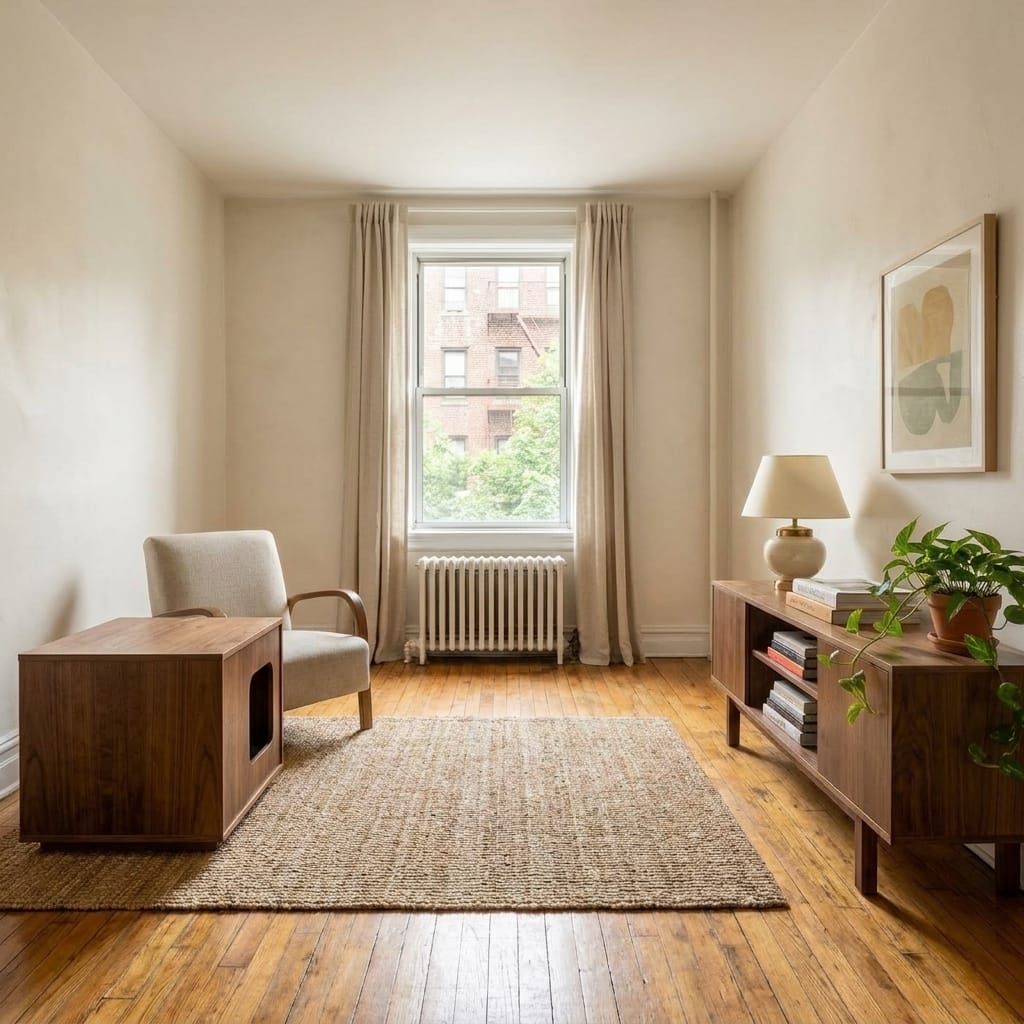
Skip to my pick: The Refined Feline Litter Box Enclosure
You did the work. The rug, the plants, the console you saved up for — the room finally looks like the one you pinned. And then there it is in the corner: a big plastic tray that tells every guest “a cat lives here” before they’ve taken off their shoes. In a studio or a one-bedroom, there’s no spare room to banish it to. The litter box has to live where you live.
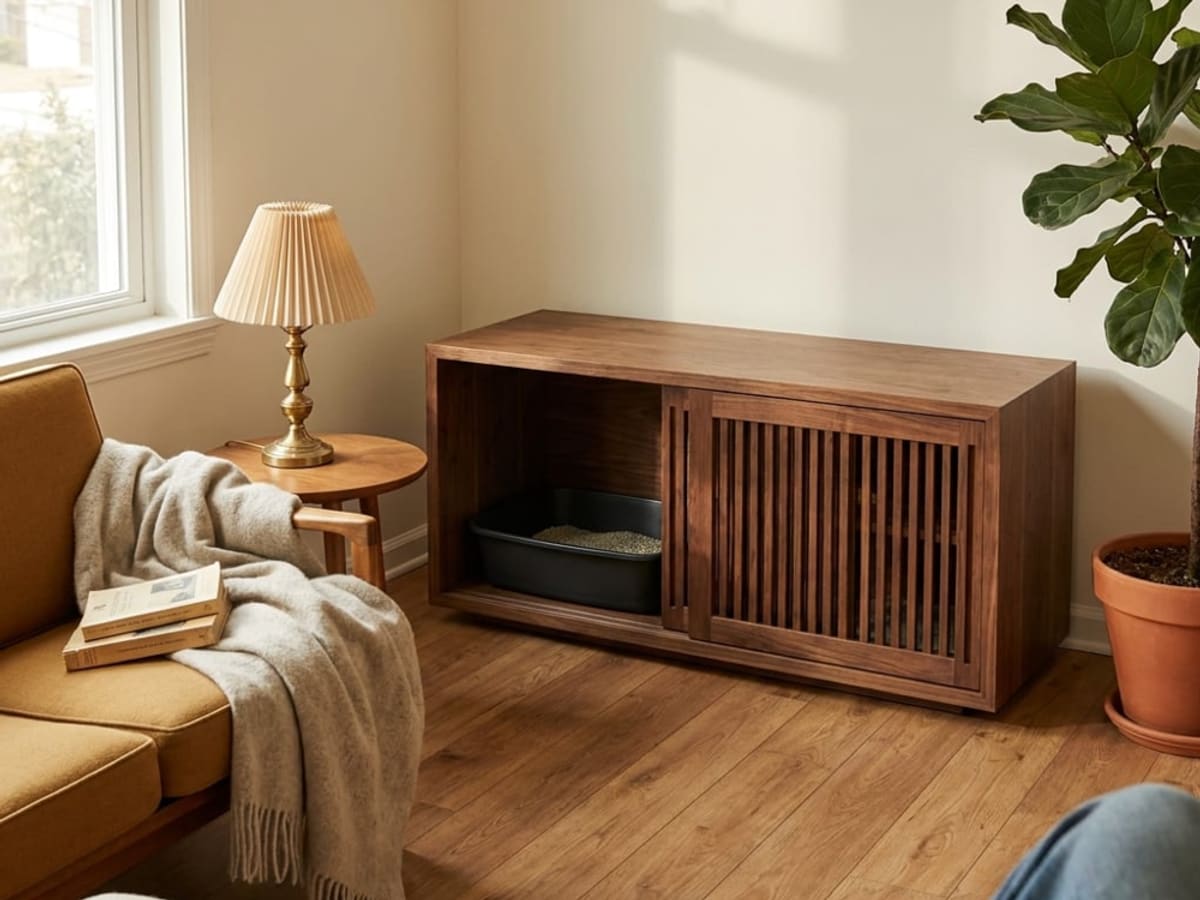
Here’s the reassuring part: you can genuinely make the box disappear without your cat staging a protest on the bath mat. The trick is to hide it from your eyes without changing the three things a cat actually cares about — easy access, a roomy pan, and good airflow. Get those right and you can tuck a box into almost any small space. Below are the methods that work, with the honest trade-offs of each.
Method 1: Furniture-style enclosures (the best all-around option)
A litter-box enclosure is a piece of furniture — a cabinet, a side table, a low bench — built with a hollow interior and a cat-sized entry cut into the side or top. The pan sits inside. From the outside it reads as a nightstand or a console, and the box vanishes into the room instead of fighting it.
This is the solution to reach for first, because it solves the problem without a compromise on either side. You get a piece that looks intentional, and your cat gets a private, dim space that many cats actually prefer. Good ones include ventilation, a door on a hinge so you can scoop without dragging furniture around, and a removable floor panel for deep cleaning.
How to choose one that works:
- Interior size first, looks second. Measure your current pan and add clearance so your cat can turn around. A cabinet that looks great but cramps the box will get boycotted.
- Check the entry. A front cat-door suits most cats; kittens, seniors, and arthritic cats need a low, wide opening rather than a high jump.
- Prioritize cleaning access. A full-swing door or a lift-off top beats a tiny hatch you have to reach through.
- Look for real ventilation. Enclosed boxes trap odor if air can’t move. Rear vents or a gap at the back matter more than they seem.
Pros: best-looking result, cat-friendly, no tools, and it doubles as a real surface for a lamp or a plant. Cons: costs more than a bare box, and a poorly chosen one can be cramped or hard to clean. To skip the trial and error, start with the furniture-style enclosures I recommend: each is judged on looks, odor control, cleaning access, and whether the cat actually fits. The one I land on has a review of its own: The Refined Feline enclosure.
Method 2: Repurpose real furniture (the DIY route)
If you’re handy, or you just want a specific look, you can convert real furniture into a litter cabinet. The classic version is the IKEA hack: a simple cabinet (the Kallax and various shoe or sideboard cabinets get used a lot) with a cat-sized hole cut into one side and the pan placed inside. An old sideboard from a secondhand shop works the same way and often costs less than a purpose-built enclosure.
How to do it well:
- Cut an entry at least as wide as your cat is long, with a smooth, splinter-free edge; sand it and cap it with edge trim.
- Seal or line the interior. Raw MDF and particleboard soak up moisture and odor over time; a wipe-clean vinyl liner or a coat of sealant on the floor and lower walls saves the piece.
- Leave the back open or drill vent holes so air moves through.
- Make sure at least one panel opens or lifts off. Building a box you can’t get into for cleaning is the most common DIY mistake.
Pros: cheapest way to a custom look, and you control the dimensions. Cons: it’s real work, unsealed particleboard degrades fast in a damp environment, and a rushed cut can leave a rough edge your cat won’t walk through.
Method 3: Use a nook, closet, or bathroom
Sometimes the best way to hide a box is to put it somewhere the eye doesn’t travel. Small apartments hide surprising options: the gap beside a wardrobe, the floor of a coat closet, the corner of a bathroom, the dead space under a console table.
Placement tips:
- A closet works only if the door stays open enough for the cat, or you fit a pet door into it. A propped door that swings shut and traps the cat will end the arrangement fast.
- Bathrooms are a natural fit: hard floors, easy to clean, and a spot most people won’t glance at.
- Under-stair and behind-furniture nooks keep the box out of sightlines while staying accessible.
Ventilation caution: the smaller and more closed the space, the more odor concentrates. A closet with the door mostly shut, or a windowless bathroom, needs airflow — leave a vent gap, run the bathroom fan, or crack a window. A sealed nook becomes a smell trap quickly, and cats will avoid a box in stale air just like you would.
Pros: costs nothing, uses space you’re already ignoring. Cons: airflow is the constant worry, and you have to guarantee the cat can always reach it.
Method 4: Screen it
If you can’t enclose the box, you can break the sightline to it. A tall floor plant, a folding room divider, or a curtain hung on a tension rod in front of a corner all hide the box from the main view of the room without boxing it in.
This is the lightest-touch method and the most renter-friendly — nothing gets cut or drilled. A leafy plant beside the box or a low screen angled across a corner is often enough to keep it from being the first thing anyone sees. Keep any plant genuinely cat-safe; skip lilies, pothos, and other toxic species entirely.
Pros: cheap, reversible, great airflow since the space stays open. Cons: it hides the box from one angle, not all of them, and it does nothing for odor on its own.
Method 5: Top-entry and high-sided boxes
Before you hide the box, you can shrink the mess and the visual footprint by changing the box itself. A top-entry box — the cat hops in through a hole in the lid — hides the litter and the contents completely from a standing view, and the lid catches most of the litter your cat kicks up. A high-sided box (tall walls, a lower cut-out entry) does the same job for cats who won’t use a covered box.
These pair well with the other methods: a top-entry box inside a bench, or a high-sided box behind a screen, gives you two layers of concealment. The trade-off is that top-entry boxes ask the cat to climb, which doesn’t suit kittens, seniors, or larger cats, so match the box to the cat you have.
Pros: less visible mess, less tracking, works with hiding methods. Cons: not for every cat, and covered designs still need airflow.
Keeping it from smelling
Hiding a box raises the stakes on odor, because you’ve reduced how much air moves around it. A hidden box that smells defeats the whole point. Three things carry most of the load:
- Litter choice. A quality clumping litter that seals waste tightly is the single biggest lever. Unscented usually beats heavily perfumed versions; cats often dislike strong fragrance, and it only masks odor rather than trapping it.
- Ventilation. Any enclosed setup needs somewhere for air to move: rear vents on a cabinet, a gap at the back of a nook, a bathroom fan. This is where hidden boxes most often go wrong.
- Scooping cadence. Scoop at least once a day — twice in a closed enclosure. Nothing you buy substitutes for removing waste promptly, and a full clean-out with fresh litter every couple of weeks keeps the pan itself from holding odor.
One related headache worth planning for: tracking. Cats carry litter out of the box on their paws, and an enclosure concentrates it right at the exit. A mat at the entry, or an enclosure with a built-in grate or scratch-pad step, catches most of it before it reaches your floor.
Where to actually put it (placement rules)
Hiding the box only works if the spot also works for the cat. A few rules hold across almost every apartment:
- Keep it easy to reach. The cat should get to the box without navigating a closed door, a leap, or a long trip across the apartment. Accessibility beats concealment every time — a box the cat can’t reach is a box the cat won’t use.
- Away from food and water. Cats instinctively won’t eliminate next to where they eat. Put real distance between the litter station and the food and water bowls.
- Quiet, low-traffic corner. Skip the spot next to the washing machine, the front door, or anywhere with sudden noise. Cats want to feel unwatched and undisturbed while they go.
- One box per cat, plus one. Two cats means three boxes. In a small apartment that’s a squeeze, but under-providing is a leading cause of accidents outside the box. If space is tight, spread them to different rooms rather than lining them up in one.
The catch (and how to mitigate it)
Here’s the honest downside nobody advertises: every method of hiding a box works against the two things a box needs most — airflow and cleaning access. Box it in and you slow the air; tuck it away and you make yourself reach for it. Both problems, left alone, lead to odor and to a cat that quietly stops using the box.
You mitigate it by designing for those two things from the start. Choose an enclosure with real ventilation and a door that opens fully. Leave a vent gap in any nook or closet. Put the box somewhere you’ll actually walk past, so daily scooping stays a habit instead of a chore you avoid. And watch the cat for the first couple of weeks after any change — hesitation at the entry, or going right beside the box, is your early warning that the airflow, the entry, or the size needs adjusting. Fix it early and the hidden box stays a hidden box.
This guide is part of my guide to modern cat furniture, which covers the rest of the pieces that make a small space work for both of you. When you’re ready to pick an actual enclosure, my litter-box furniture roundup walks through specific options and the trade-offs of each.
Other litter-box questions
- How to stop litter tracking everywhere
- Where to put a litter box in a small apartment
- Self-cleaning vs manual litter box: which should you get?
FAQ
Do cats mind an enclosed litter box?
Most cats are fine with an enclosed box, and many prefer the privacy and the dim, sheltered feel. The two things that turn a cat off are a cramped interior and stale, poorly ventilated air. Give the cat enough room to turn around, keep air moving through the enclosure, and provide a low, easy entry, and the great majority of cats accept it without any fuss. Introduce it gradually and watch for hesitation in the first week or two.
Where should I put a litter box in a studio apartment?
Look for a quiet, low-traffic corner that’s away from your bed and well away from the cat’s food and water. A bathroom, a coat closet with the door propped or fitted with a pet door, or a corner concealed by a furniture-style enclosure all work in a studio. The priority order is access first (the cat must always reach it), then odor control (airflow and daily scooping), then how well it hides.
Does hiding a litter box make it smell worse?
It can, if you hide it without keeping air moving. Enclosing a box slows ventilation, which lets odor concentrate. You avoid this with a good clumping litter, real airflow (rear vents, a gap at the back, or a running bathroom fan), and scooping at least once a day — twice for a closed enclosure. Done that way, a hidden box smells no worse than an open one.
Is it bad to keep a litter box in the bathroom?
Not at all — bathrooms are one of the best spots in a small apartment. The floors are easy to clean, it’s usually quiet, and most guests never look. The main things to manage are airflow in a windowless bathroom (run the fan or crack the door) and keeping the box away from the cat’s food. Just make sure the door can’t swing shut and lock the cat out.
How do I hide a litter box from my dog?
Dogs raiding the litter box is a common problem, and the fix is an entry only the cat can use. A furniture-style enclosure or a cabinet with a cat-sized opening keeps most dogs out, and a top-entry box adds another barrier since the cat jumps in from above. For a determined or small dog, a baby gate with a cat-sized gap, or a pet door sized to the cat, seals it off. Keep the box itself accessible to the cat at all times.
Can I use a furniture enclosure in a rental?
Yes, and it’s one of the most renter-friendly options because nothing is attached to the walls or floor. A standalone enclosure sits like any other piece of furniture, leaves no marks, and moves with you. If you’d rather not buy one, screening the box with a plant or a freestanding divider is even lighter-touch and equally reversible.