
Skip to my pick: The Refined Feline Litter Box Enclosure
You sweep on Monday. By Wednesday there’s grit under your bare feet in the kitchen, a scatter of granules by the couch, and a fine trail leading from the litter box to — somehow — the bathroom on the far side of the apartment. In a small place, litter tracking stops feeling like a nuisance and starts feeling like a losing battle.
Here’s the reassuring part: tracking is one of the most fixable cat problems there is. It’s not a training issue and it’s not your cat being difficult — it’s simple physics. Granules lodge between paw pads and get flung out by digging, then ride your cat, the air, and your own feet around the room. Once you know the two places litter escapes — stuck to paws and kicked over the wall — you can block both. Below are the methods that actually reduce tracking, with honest trade-offs, so you can layer the ones that fit your apartment.
01. Litter mats: your first and biggest line of defense
A litter mat sits in front of the box and catches granules off your cat’s paws as it steps out: the single highest-impact fix for most people, because it targets the exact moment litter leaves the box. But not all mats work the same way, and the wrong one just becomes a second thing to clean. The three common types trap litter differently:
- Ridged rubber or EVA-foam mats have a raised honeycomb or grid texture. Paws press into the ridges and granules drop into the recesses below, staying there until you shake or vacuum the mat. These are the workhorses: easy to rinse, durable, and genuinely effective.
- Double-layer “sifting” mats have a perforated top sheet over a sealed tray. Litter falls through the holes into the pocket between layers, out of your cat’s path, and you lift the top to pour it back. These catch the most, but cost more and are fiddlier to empty.
- Carpet-style or microfiber mats look tidier and some cats prefer the texture underfoot. They grab fine dust well but hold granules in the fibers, so they need frequent vacuuming and trap less than a deep ridged mat.
How to use one so it actually works: make it big. A small mat gets one or two steps before your cat clears it; a larger mat, deep enough for several paw-falls, catches far more. Place it so the cat has to walk across it to leave, not around it. And empty it on a schedule; a full mat stops trapping and starts spreading.
Pros: cheap, no change to your cat’s routine, immediate results. Cons: even the best mat catches paw litter, not the granules kicked over the wall while digging, so a mat alone rarely solves tracking on its own.
02. Top-entry and high-sided boxes: stop the kick-out
The second escape route is the litter your cat flings over the side while burying. A standard open box with low walls does nothing to contain an enthusiastic digger, and that scattered litter lands on the floor where paws and feet carry it onward.
Two box designs fix this:
- High-sided boxes have tall walls, often with a lower cut-out for entry. The height keeps kicked litter inside the pan. They suit most cats and require no behavior change, since the cat still walks in at floor level.
- Top-entry boxes take it further: the cat hops in through a hole in the lid, and the enclosed shape plus the perforated lid means almost nothing escapes. The lid also grabs litter off paws on the way out, doubling as a built-in mat.
How to choose: match the box to the cat you have. Top-entry boxes ask the cat to jump in and out, which doesn’t suit kittens, seniors, arthritic cats, or very large cats; for them, a high-sided box with a low entry is safer. Give any box enough floor area for your cat to turn around; cramping the pan just creates new problems.
Pros: attacks the kick-out mats can’t, and top-entry lids double as a paw filter. Cons: not every cat will climb into a top-entry box, and covered designs need airflow or they trap odor.
03. Low-tracking litter: change what’s escaping
If mats and boxes control where litter goes, the litter itself controls how far it travels once loose. Some formulas simply scatter more than others, and switching type can noticeably cut what ends up across the room. A few honest guidelines:
- Heavier, larger granules travel less. Lightweight litters — especially some crystal and highly aerated formulas — are easy for paws to fling and for air to carry. Denser, coarser granules drop off paws faster and stay put.
- Low-dust formulas keep it off your floors and your cat’s lungs. Fine dust is the version of tracking you can’t see until it films every surface. Litters labeled low- or no-dust cut this considerably.
- Some litters market themselves as “low-tracking.” This usually means a granule shape and weight tuned to fall off paws quickly, a real difference for many cats, though results vary.
How to switch without upsetting your cat: change litter gradually. Mix a little of the new into the old over a week, increasing the ratio each day. Cats can be particular about texture underfoot, and a sudden swap sometimes makes a cat avoid the box entirely — a far bigger problem than tracking.
Pros: reduces both scatter and fine dust at the source; easy to combine with everything else here. Cons: the lowest-tracking litter for your cat is partly trial and error, and switching too fast risks a boycott.
04. Contain it inside a furniture-style enclosure
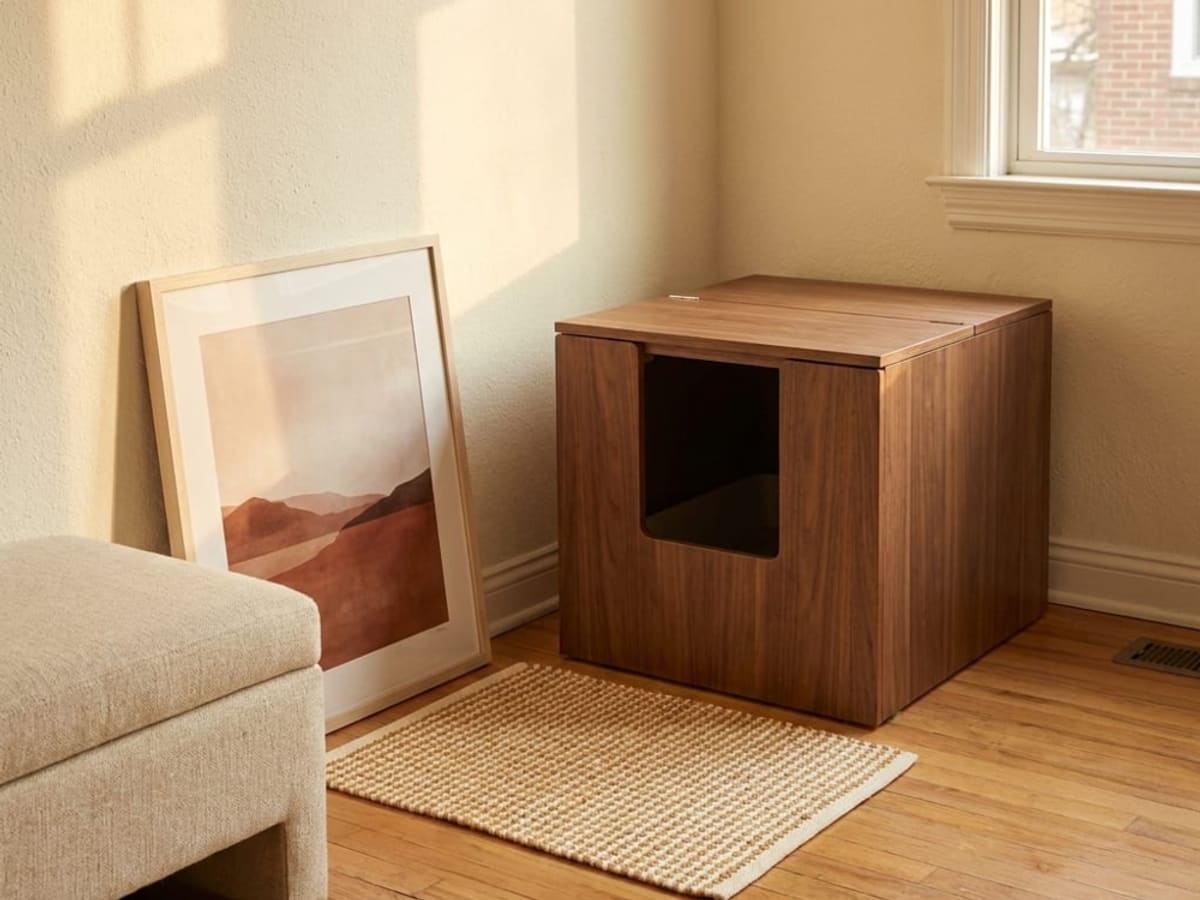
Mats and boxes reduce tracking; an enclosure physically corrals whatever’s left. A furniture-style enclosure is a cabinet or bench with a hollow interior and a cat-sized entry: the pan sits inside, its walls catch flung litter, and paw-shed granules concentrate into one small area at the exit, where a mat or a built-in grate step can grab them.
It’s worth reaching for if tracking has been stubborn, because it tackles both escape routes at once: the walls stop the kick-out, and the confined exit is the perfect place to force your cat across a mat before it reaches open floor. As a bonus, the box stops being the first thing guests see. Look for a model with a built-in scratch-pad or grate step at the doorway, a mat your cat can’t route around.
To skip the trial and error on which cabinets are cat-friendly and easy to clean, start with furniture-style enclosures: each is judged on looks, odor control, cleaning access, and whether the cat actually fits.
Pros: contains kick-out and paw-shed together, hides the box, and gives you a defined spot to trap litter at the exit. Cons: costs more than a mat, and a poorly ventilated or cramped enclosure creates odor and access problems of its own.
05. Placement and a two-minute cleaning routine
Where the box lives and how you keep up with it is the last piece. Smart placement shortens the trail, and a quick routine stops escaped litter from spreading through the apartment.
Placement that limits the spread:
- Put the box against a wall or in a corner so kicked litter hits a barrier instead of scattering into open floor.
- Keep it off soft flooring where possible. Litter buries into carpet and gets tracked much farther; a hard floor, or a large mat under the whole station, is easier to contain and clean.
- Don’t bury the box down a long hallway. Every step across the apartment is another chance to drop granules, so a box near where the cat already spends time means a shorter tracking path, not a longer one.
A routine that keeps it in check:
- Daily: scoop the box, then shake the mat out over the box or a bin. Two minutes.
- Every few days: vacuum or sweep the immediate area around the station. Catching litter early stops it migrating room to room.
- Every couple of weeks: empty and wipe the mat fully, and deep-clean the box and the floor beneath it.
Pros: costs nothing, and consistency beats intensity: small daily upkeep prevents the whole-apartment spread. Cons: it’s a habit, and habits lapse; the fewer steps, the more likely you keep it up.
This guide is part of my guide to hiding a litter box, which covers the rest of making a litter station disappear into a small apartment.
FAQ
What is the best way to stop litter tracking?
There’s no single fix — the reliable approach is to block both escape routes at once. Put a large ridged or double-layer mat at the box exit to catch paw litter, use a high-sided or top-entry box to stop the kick-out, and switch to a heavier, low-dust litter. Layering two or three of these cuts tracking far more than any one alone, and a daily shake-out of the mat locks in the difference.
Do litter mats actually work?
Yes, a good one makes a real difference — but only for litter stuck to your cat’s paws, and only if it’s big enough. A large mat the cat must fully cross catches a meaningful share; a small one, or one the cat can step around, does little. Mats do nothing for litter kicked over the box wall, which is why they work best paired with a high-sided or covered box.
Does low-tracking litter really make a difference?
For many cats, yes. Heavier, coarser granules fall off paws faster and are harder to fling than lightweight ones, and low-dust formulas cut the fine grit that films every surface. The best litter is partly cat-specific, so expect some trial and error, and transition gradually over a week; a sudden change sometimes makes a cat avoid the box.
Why does my cat track litter so far across the apartment?
Two reasons compound. Granules lodge between the paw pads and drop off step by step, so a longer route from the box means a longer trail; and fine dust rides on paws and in the air, settling well beyond the box. A short, well-placed location, a mat at the exit, and a lower-dust litter each shorten the trail. Hard flooring helps too, since litter buries into carpet and travels much farther.
Are top-entry litter boxes good for reducing tracking?
They’re among the most effective designs. The cat enters through the lid, so kicked litter stays inside, and the perforated lid grabs granules off the paws on the way out. The catch is the climb: it doesn’t suit kittens, seniors, arthritic cats, or very large cats. For those, a high-sided box with a low entry gives similar containment without the jump.
How often should I clean up tracked litter?
A light daily touch beats an occasional deep clean. Scoop and shake out the mat once a day, and sweep the immediate area every few days so escaped granules don’t migrate through the apartment. A fuller clean of the mat, box, and surrounding floor every couple of weeks keeps it from building up. The daily routine takes about two minutes.