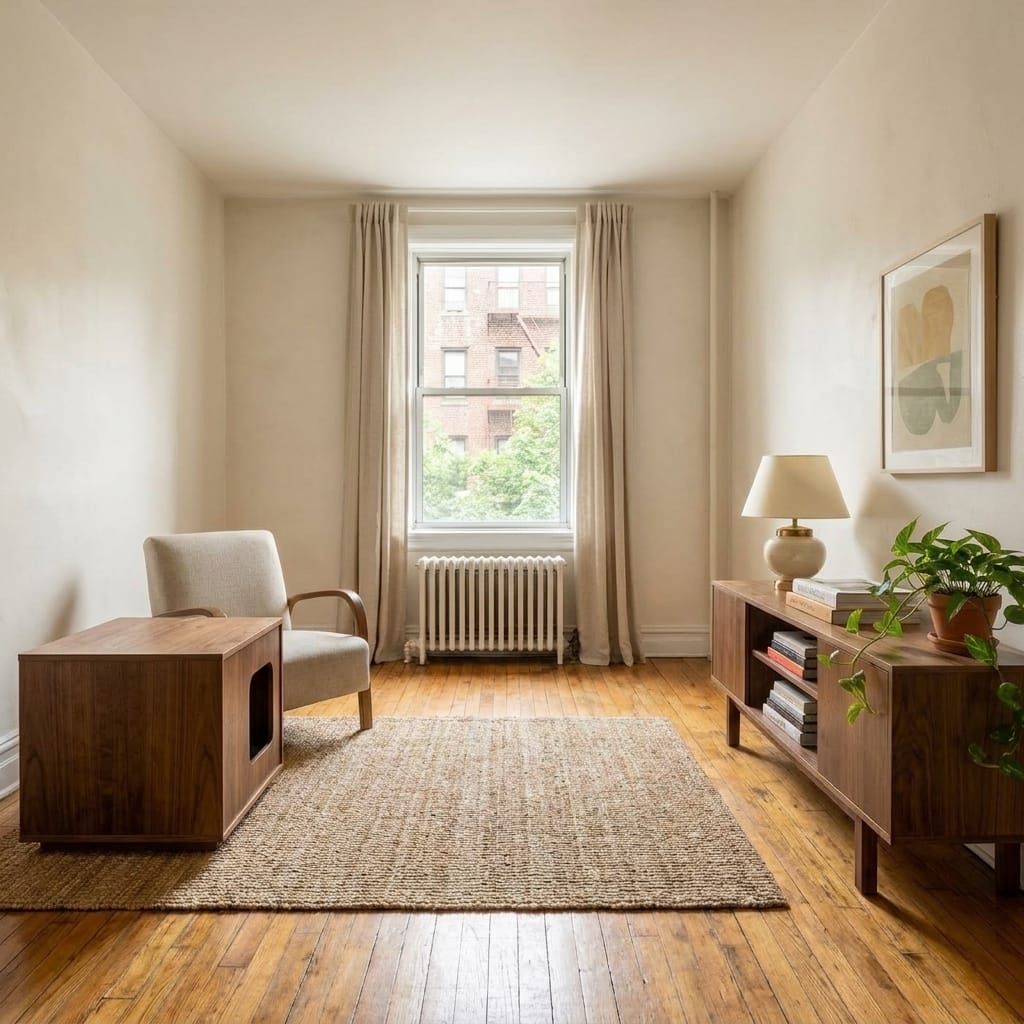
Skip to my pick: The Refined Feline Litter Box Enclosure
In a small apartment, the litter box has to go somewhere, and every somewhere is also somewhere you live. There’s no spare bathroom to banish it to, no laundry room, no basement corner. The box competes for the same square footage as your bed, your desk, and your dinner. So the question isn’t really “where can it fit” — you can wedge a pan almost anywhere — it’s “where does it fit for the cat and for you,” at the same time, in a space that doesn’t have room to waste.
That tension is real, but it’s solvable. Cats care about a short, specific list of things when they choose whether to use a box. Once you know that list, you can find the spot in your studio that satisfies it and still leaves your home feeling like a home. This guide covers the principles, the actual spots that work in a small space, how many boxes you need, and how to make the box disappear once you’ve placed it.
The placement principles that actually matter
Before you pick a corner, understand what a cat is grading you on. Get these right and almost any location can work; get them wrong and even a “perfect” spot gets boycotted.
- Easy, reliable access. The cat should reach the box without a closed door, a big leap, or a trek across the apartment. Access beats every other consideration: a box the cat can’t get to on its own terms is a box the cat won’t use. This matters even more for kittens, seniors, and arthritic cats, who need a low entry and a short trip.
- Quiet and low-traffic. Cats want to feel unwatched and undisturbed while they go. Skip the spot right next to the front door, the loudest wall, or a noisy appliance that kicks on without warning. A startled cat learns to associate the box with the scare and starts avoiding it.
- Away from food and water. Cats instinctively won’t eliminate next to where they eat. Put real distance — as much as your floor plan allows — between the litter station and the food and water bowls. In a studio this is one of the harder rules to honor, so treat it as a priority when you lay things out.
- Some ventilation. Odor concentrates fastest in small, closed spaces. The spot needs somewhere for air to move: a cracked door, a bathroom fan, a nearby window, or at least an open side. A box in stale, trapped air smells worse and gets used less; cats dislike a smelly box as much as you do.
- Not tightly cornered. A box jammed into a corner with walls on two sides and a lid on top gives the cat only one way in and out. Cats prefer to see an exit; a spot with a little room to enter and turn around beats one where they feel trapped. Give the pan breathing room even when space is tight.
Notice the built-in conflict: the most hidden spots are usually the least ventilated and the hardest to reach. Every placement decision below is really a negotiation among these five, and the honest goal is a spot that’s good enough on all of them rather than perfect on one.
The spots that work in a studio
Here are the realistic locations in a small apartment, with the trade-offs of each.
The bathroom. For most small apartments this is the best all-around spot, and it’s where I’d start. The floors are hard and easy to clean, it’s usually the quietest room, it’s naturally separate from where you eat, and guests never look. Two cautions apply. First, ventilation: a windowless bathroom traps odor fast, so run the exhaust fan or leave the door cracked. Second, access: the door can’t be allowed to swing shut and lock the cat out: prop it, add a doorstop, or fit a cat-sized pet door into it.
A closet with the door cracked. The floor of a coat or utility closet hides a box well and uses space you’re barely using. The entire arrangement lives or dies on the door, though. It has to stay open enough for the cat to pass at all times, which usually means a doorstop or a pet door; a door that drifts shut and traps the cat will end the setup overnight. Ventilation is the other worry: a mostly-closed closet is a smell trap, so leave a real gap for airflow and scoop more often than you would in the open.
Under a console or bench. The dead space beneath a console table, a media unit, or a low bench is often the cleanest way to place a box in the main room. It keeps the pan out of your direct sightline while leaving the sides open, so airflow and access both stay good, a genuine advantage over a closed nook. The trade-offs are height (make sure the cat can stand and turn under there, and that you can reach in to scoop) and containment (an open-sided spot does nothing for tracking on its own, so add a mat at the exit).
An entryway nook. The gap beside a shoe rack or in the corner by the door can absorb a box when nothing else will. Be honest about the downsides here: entryways are high-traffic and often noisy with the door opening and closing, which works against the “quiet” rule. It also puts the box near where people come and go, so a startled cat has an audience. Use this spot when it’s genuinely the only option, buffer it with a screen or plant, and watch the cat closely for signs of stress.
One note spans all four: the more enclosed the spot, the more aggressively odor builds. Any closed or semi-closed location (closet, cabinet, windowless bath) needs deliberate airflow and a slightly heavier scooping schedule. When a spot fails, stale air is usually why.
How many boxes, and what to do in a studio
The standard rule is one box per cat, plus one: so one cat needs two boxes, two cats need three. Under-providing is a leading cause of accidents outside the box, and it’s the mistake small-apartment owners make most, because the math feels impossible in 400 square feet.
You have two honest options in a studio. If you truly have room for only one box, commit to keeping that single box immaculate — scoop twice a day, full change-outs on schedule — and watch closely for protest; many single-cat households get away with one box this way. The better option is to fit the extra box but spread the boxes to different zones rather than lining them up side by side. Two boxes touching in one corner read to a cat as one big box; the same two placed in, say, the bathroom and under a console genuinely reduce accidents. Distance is what counts, not just the count.
Making the box disappear once it’s placed
Placement and concealment are two different jobs. Once you’ve chosen a spot that satisfies the cat, you can hide the box from your own eyes without changing anything the cat cares about, as long as you protect airflow and cleaning access while you do it.
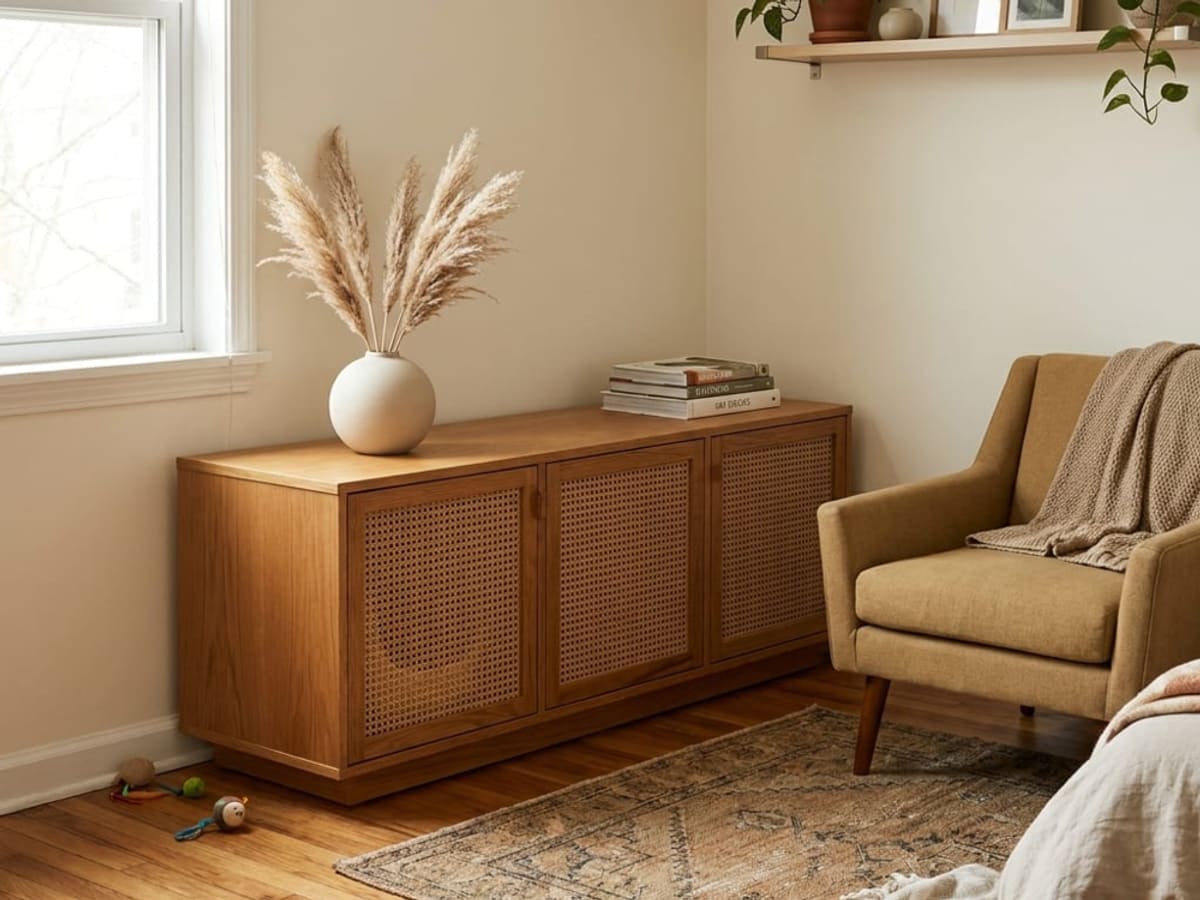
The cleanest solution is usually a piece of furniture built for the job. A cabinet or bench with a hollow interior and a cat-sized entry reads as a nightstand or console while the pan hides inside; see the furniture-style enclosures I recommend for options judged on looks, odor control, and whether the cat actually fits. If you’d rather work with the spot you have (screening a corner, using a nook, or converting existing furniture), my full guide to how to hide a litter box walks through each method and its trade-offs.
Concealment is just one piece of making a small space work for a cat without surrendering the room to it. For the bigger picture — where the box fits alongside scratchers, perches, and seating — see my cat-friendly living room ideas.
FAQ
Where should I put a litter box in a studio apartment?
Start with the bathroom if you have one: quiet, easy to clean, separate from food, and out of guests’ sight, making sure the door can’t lock the cat out and the room gets some airflow. If the bathroom won’t work, look at a cracked-open closet, the space under a console or bench, or a buffered entryway nook. Whichever you pick, judge it on access first, then odor control, then how well it hides.
How far should the litter box be from food and water?
As far as your floor plan allows. Cats instinctively avoid eliminating next to where they eat, so putting the box across the room from the bowls — or in a different zone entirely, like the bathroom while food stays in the kitchenette — respects that instinct. In a tight studio you may not get much distance, so treat separation as a priority when you decide what goes where.
Can I keep the litter box in the bathroom?
Yes. For most small apartments it’s the best spot. Hard floors make cleanup easy, it’s usually the quietest room, and it’s naturally away from food. The two things to manage are ventilation in a windowless bathroom (run the fan or crack the door) and making sure the door can’t swing shut and trap the cat. A doorstop or a cat-sized pet door solves the access problem.
How many litter boxes do I need in a small apartment?
The guideline is one box per cat plus one, so one cat ideally has two and two cats have three. In a studio that’s a squeeze, but under-providing causes accidents. If you can only fit one, keep it spotless and watch for protest; if you can fit the extra, place the boxes in separate zones rather than side by side, since two boxes in one corner act like a single box to the cat.
Is it okay to put a litter box in a closet?
It can work well if you solve two things. The door has to stay open enough for the cat to pass at all times: use a doorstop or fit a pet door, because a door that drifts shut and traps the cat ends the arrangement fast. And a mostly-closed closet traps odor, so leave a real gap for airflow and scoop more often than you would in the open.
Will hiding the litter box make my apartment smell?
Only if you hide it in a way that starves it of air. Enclosing or tucking away a box slows ventilation and lets odor concentrate, so pair any hidden spot with good clumping litter, deliberate airflow (a vent gap, an open side, or a running fan), and daily scooping, twice a day for closed setups. Done that way, a hidden box smells no worse than one out in the open.